Unlike Rick from Casablanca, we made the plane to Lisbon, and I'm glad we did. Portugal and Lisbon have always been places I've wanted to visit ever since seeing that movie. It holds a certain amount of mystery to me. You don't hear much about Lisbon and Portugal in the world news. It seems like a little bit of the backwater of Europe. The slower pace seems inviting, and the people are some of the friendliness I have been around.
We stayed right off Rossi Square at the base of Castelo De St George. We tried to walk up to an overlook the day we arrived, but it was closed for maintenance. Several other tourists did the same thing. Along the way, several street fairs were going on. All the street graffiti art along the way was not lost and made the trip worth wild. Lisbon has an ancient feeling, unlike other European cities except for Rome. It seems this is due to its Moorish and African influences. Some of the food that is Portuguese cuisine are olives, sardines, and octopus. I tried all 3 tonight for dinner. I was very surprised by the octopus on how tender (melt in your mouth) and smooth it was.
Over the next few days, we got into the meat of Lisbon. The Portuguese are proud of their colonial history, with monuments to their explorations everywhere. Lots of Brazilian Tourists. We went to the Arch of Triumph and Castle at Belem, the ceremonial starting point of all those 16th Centuries explorers you learned about in High School. Which is near their Naval center and the tomb of the unknown soldier. We also discovered that the pigeons eat well here, scavenging at all the major monuments.
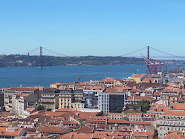
The view from Lisbon's St. George Castle commands the city and waterfront. Although human habitation of the castle hill is thought to begin around the 8th Century BC. "The hill on which Saint George's Castle stands has played an important part in the history of Lisbon, having served as the location of fortifications occupied successively by Phoenicians, Carthaginians, Romans, and Moors before its conquest by the Portuguese in the 1147 Siege of Lisbon. Since the 12th century, the castle has served as a royal palace, a military barracks, the Torre do Tombo National Archive home, and now as a national monument and museum." Some perspective here, this all happened 300 years before Columbus and 600 years before the American Revolution. After touring the castle, we walk through the Alfama, one of Lisbon's oldest neighborhoods, originally settled by Portuguese sailors,
On our last day in Lisbon, we are taking a down day to pack for our trip to Madrid. It's been fun here in Lisbon, and we learned a lot. The country is surprisingly diverse, with the population reflecting its colonial past. It's a great example of the Columbian Exchange (world trade after Columbus), With Brazil being the most closely connected with Portugal. Well, we decided to take one last walk-thru Town. I'm glad that we did. We saw some neat stuff and a completely different view of the city.
Just some thoughts on Lisbon and Portugal. The climate is much like Southern California. Hot and dry summers and very mild winters, not much humidity. It's easy to see why Portugal has 640K ex-pats living here. It is one of the most inexpensive countries in the EU to live in. The cost of living is about 50% lower than in the US, although Lisbon, like any other major city, is higher. Gas is currently $8.78 a gallon, and cars are much smaller, averaging 40 miles a gallon.
We did not speak to another American while we were here. The people in the restaurants were most friendly with us. Talked to a few Brits, and one from Cambridge, England, said, "you're an American from the west coast." He guessed correctly; I said, "I was born in Hawaii and grew up in Washington State. I told him we now lived in Tennessee near Nashville, where they make Jack Daniels whiskey." It's funny many times; people don't know where Tennessee or Nashville is, but you say Jack Daniels, and everyone's eyes light up. They know where that's at.


